

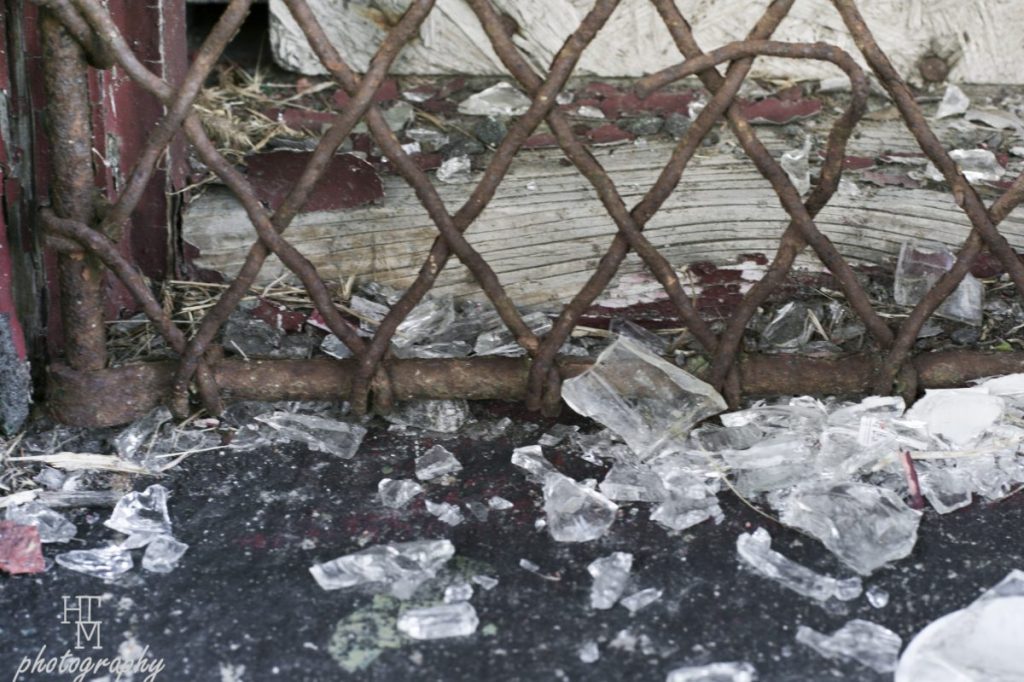
One of the recent wordpress.com weekly photography challenges was “texture.” I like the idea of texture in a photo so I gathered the photos that I thought exhibited texture. There were several dozen of them but I kept coming back to half a dozen of them. They were far from being the best ones for this project but as for many photos of the past they elicited memories laden with emotions.
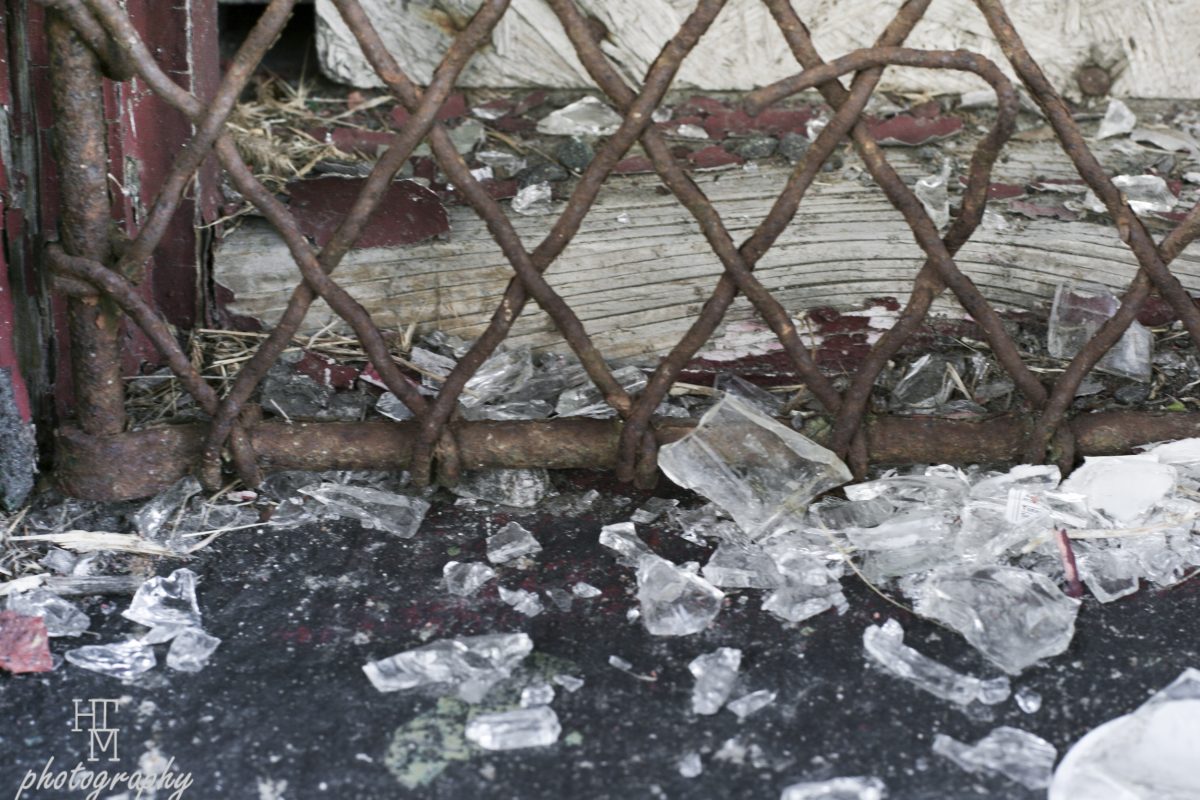


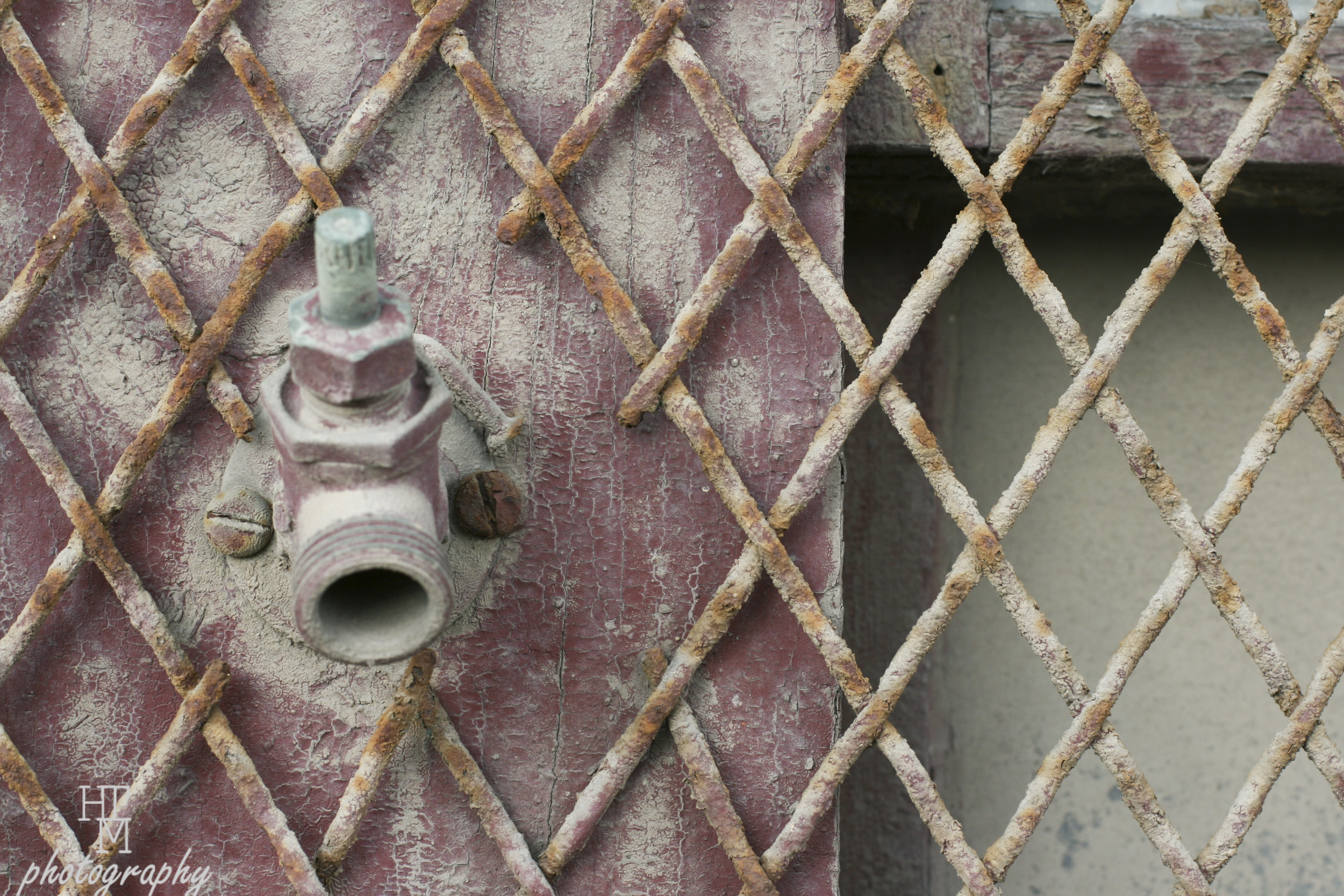
The texture in these photos is composed of the shards of glass, rusted window grills, shavings of a neglected outer structure and the outside of the building itself. These photos that exhibit so much texture imply a building that is slowly deteriorating.
As I peer closely into these fragments of glass I am transported back to me a time over 50 years ago when I was a student working a summer job in this building. I see myself walking up the worn wooden steps to the top floor that opens to a large space filled with row upon row of sewing machines. To the left as I enter this space there is a wooden box with slotted sections bolted to the wall. This box contains time cards. I pick up my time card and insert it into the time clock and listen to the sound of the machine punching a hole in the time card to verify my time of arrival. My start time duly verified, I walk to a large table at the back of the room that is heaped high with girl’s dresses. I put my lunch and jacket aside and begin to inspect each piece of clothing for any flaws while snipping stray threads. The pile never seems to diminish. In the large open space behind me the seamstresses are hard at work sewing pieces of cut-out material that eventually makes girl’s dresses. These garment workers are doing piece-work and so are paid according to how many pieces they can sew. They work fast and steady and every quarter of an hour or so a new load of dresses arrives at my table. As I work I am aware of the smells of newly bought material, the oil of the sewing machines, the old dry wood of the floor and walls and even of the lunches packed away waiting for the lunch bell to ring. It all mingles together to give a unique rancid, woody, old, and musty scent. Yet there is something soothing about it all. The machines whirl, the floor lady rolls her huge canvas cart as she picks up the clothes from one seamstress to bring to another. There is no talking, only the arms and hands move at lightning speed that belies the years of training and practice needed to polish their craft to this pitch of excellence. There is a rhythm to the pace and a rough, grainy texture to the whole scene.
This is a factory that manufactures children’s dresses. It is a large brick factory facing the Hudson River known as Tiny Town Togs and as far as I can evaluate it is a “sweat shop.” I work 8 hours a day, I am required to get permission to use the ladies room and I have ½ hour for lunch. It is the only time during the 8 hour shift that I can sit. By the time my shift is over my legs are double their size and pulsing with pain.
I have had many jobs in my life, some pleasant and some not so agreeable. I will always remember this factory job with fondness. Not because it was enjoyable because it really wasn’t. What I remember most about this job are the three women who wrapped me in their protective sheath and guided me as I learned to navigate the inflexible and stringent behavior of management and to discover what it means to work a real job. They recommended me for the job when I could not find a summer job that I desperately needed to continue my education and they supported me and welcomed me into their inner circle of garment workers. They are known not by their Christian names but as they are known to each other and to all the other seamstresses – Smitty, Bauer, and Queenie. They are respectively my grandmother, great aunt and their friend – all trained garment workers striving to make a living. Smitty and Bauer are immigrants from Germany and Queenie is of Italian descent. As I watch them work day after day I become fascinated by their stories, awed by their camaraderie and willingness to work together and respectful of the care, pride and attentiveness to their craft. I am honored to be one of them if for just a short time.
They are all gone now and the factory is in decay. Their spirits live on in my mind and in the memory of those few months in 1967. I gained valuable lessons and I learned to always remember my wonderful down to earth humble roots.
So are these memories that my mind brings forward, fragments of what really happened during those years or are they laced with some real and some imaginary events? How clear and truthful is memory anyway? Perhaps it makes no difference. In yoga we talk about karma or the actions that we send out to the world that produce ripple upon ripple of effects that spread out until there is a huge wave that affects all of us. This short time spent in this factory in Troy NY was a ripple that expanded over time in my own life that I probably and hopefully sent out to the world.
 Yoga & Tai Chi
3 responses to “The texture of memories”
We all need to feel that we belong somewhere and are protected. Your focus on the valuable lessons rather than the uncomfortable conditions makes me feel like I am briefly adopted by this circle of spirits that still send positive ripples as you do.
LikeLike
Thanks Donna,
I think the best lessons are often cloaked in the challenges.
LikeLike
[…] of orange. This exercise was interesting because like the challenge I took on several years ago (the texture of memories) it took on a life of its own. I began to become aware of items and scenes that I hadn’t […]
LikeLike