


Back to Yoga Teacher Talk
Yoga movements occur at different levels. On one level the poses transition from from one position in space to another, For example, we can move from a supine (on the back) position to table position or from a seated position to a belly down orientation. Mountain Pose (tadasana), table pose (bharmanasana), sphinx (salamba bhujangasana), corpse pose (savasana), easy sitting pose (sukhasana) are all great starting platforms from which to spring to other poses. From mountain pose (tadasana) arises all standing poses; from seated staff pose (dandasana) arises all seated movements, forward bends and twists; from simple crocodile pose (makarasana) arises all the back extensions; from corpse pose (savasana) arises all the poses that are performed on the back; and from table pose (bharmanasana) arises most of the kneeling poses.
On another level we can guide the movement of one particular pose. This level involves several phases:
- Guiding the entry into a pose
- Crafting the alignment and structure of the pose
- Diving deeper into the kinesthetics of what is evolving inside during the pose
- Transitioning gracefully out of a pose to the next pose
A few weeks ago I wrote about how important it is to move gracefully from one spatial orientation to another (click here for that post) and I discussed how to move between different spatial orientations. Today’s post addresses the importance of guiding the movement into and out of a pose. There are hundreds if not thousands of ways to do this, perhaps as many ways as there are teachers. Communicating to our students how to enter a pose is difficult. We may speak the same language but we don’t all hear the same way nor do we interpret what we hear in the same way. Throw into the mix the differences in body awareness among students in any given class and it becomes a herculean task to get the languaging simple and clear enough so that everyone understands what to do. Using language cues to guide students through a yoga practice has been and continues to be a struggle for me.
I am coming to the idea that many teachers have offered and that is to guide students into a pose by verbal cues that direct body movement and NOT by giving the name of the pose. I have myself been in too many classes where the language cues are too complicated and windy to be of any other use than confounding and obtuse. Take for example this instruction for entering into standing forward bend (uttanasana) from mountain pose (tadasana).
“On an inhale stretch your arms up overhead and extend from your low belly up to your fingertips. Exhale maintaining this length bend forward from the hips and touch the earth. Keep the space between the belly and thighs, hold the big toes. Use the inner thighs to widen your sitting bones inhale and draw the sides of your waistline up and root your tailbone down… and it continues.”
Not that the instructions are wrong but by the time I have located the space between my belly and thighs and figured out how to draw up the sides of my waistline I am confused and not sure if I am doing anything correctly.
I needed to find my own voice in how I transition students from pose to pose. While books, CDs and DVDs help they are not always, and in most cases are not, how I would verbalize instructions to my students. In the examples below I am only instructing transitions from one pose to another. I am using very simple language as I have found from experience that telling my students to press their inner thighs back while opening their hips and straightening the upper back just does not work. There will be another list that talks about what you say when students are in the pose.
So here is a list of a few of my languaging cues. They are meant simply to guide a student into a pose in the most direct and clear way possible. Once in the pose there is another set of instructions to craft the pose to arrive in the appropriate structure for that particular pose and yet another set of languaging cues for diving deeper into the sensations and feelings that may arise while holding the pose. Most of the time these instructions are informed by the reactions of the students in front of me at that time.
For guiding students into a pose I learned a simple formula to craft my cues:
Breath cue + Verb + Body Part + Direction + Location= Clear Instruction
Here are a few examples:
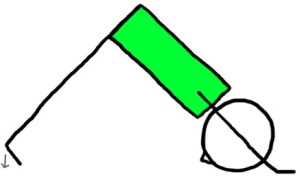
Down Dog (Adho Mukha Svanasana)
Starting Position: Table (bharmanasana)
Exhale: Lift the buttocks, raising knees and releasing chest toward the feet.
Breathing fully continue to press your chest towards your feet and your heels towards the floor.
Low Lunge (Anjaneyasana)
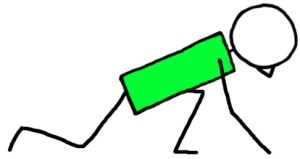
Starting Position: Down Dog (adho mukha svanasana)
Inhale: lift the right leg to the sky
Exhale: step your foot to the floor between your hands, lower the back knee to the floor & slide the knee backwards until you feel a comfortable stretch in the thigh of the back leg. Place the top of the back foot on the floor.

Cobra Pose (Bhujangasana)
Starting Position: Table (bharmanasana)
Inhale: Walk arms forward as you shift the hips forward.
Exhale: Keeping elbows close to the ribs lower your body down to the floor positioning hands palm-down under your shoulders with elbows raised.
Inhale: Engage the back muscles and raise the chest without pressing down on the hands.
Exhale: Lower chest to floor.
So you get my drift I hope. The next two examples are not color coded to allow for less distraction.

Twist (Ardha Matsyendrasana)
Starting Position: Seated Staff Pose (dandasana)
Inhale: Place both feet flat on the floor, knees pointing to the ceiling.
Exhale: Lay the right leg under the left thigh folding the knee to the floor.
Inhale: Position the left leg over the right leg with the foot flat on the floor close to the right knee.
Exhale: Anchor the left hand on the floor behind you and wrap the right arm around the left leg hugging the leg towards the middle of your chest.
Inhale: Lengthen the spine.
Exhale: Twist from the navel looking over the left shoulder. Repeat on the other side
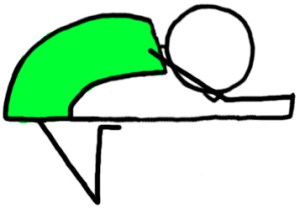
Head to Knee Pose (Janu Sirsasana)
Starting Position: Seated Staff Pose (dandasana)
Exhale: Fold left leg in toward right leg resting left foot against right inner thigh
Inhale: Circle arms out to sides and up over head lengthening the spine
Exhale: Reach arms forward lower them to the left shin, ankle, foot, whatever can be reached comfortably.
Inhale: Look up and over the toes to lengthen the spine.
Exhale: Lower the chest toward the thigh.
The initial action word that I use to move students into a pose, aside from the breath cue, will often determine how well the instructions are received. Here are some of my favorite action words and phrases: They are simple and direct.
- step the foot forward,
- lift the leg to the sky (used in moving from down dog to lunge),
- extend the leg straight behind you (sunbird),
- flex or bend the knee
- extend the leg or arm
- raise or circle the arms overhead
- circle the arms out to the sides,
- rotate the feet left or right
- pivot on the heel or toes
- peel the arms away from each other (used in Warrior II, virabhadrasana II),
- shift the hips forward or shift the hips back,
- press your heels to the ground (used in down dog, adho mukha svanasana)
- engage your back muscles (especially useful in backbends like cobra, bhujangasana)
- glide the leg forward or backward
- fold forward (useful in forward bends)
- drape your chest over your thighs (useful in standing forward bend, uttanasana)
Students may get lost once they are in a pose but they should never lose their way getting into the pose. I believe it is my job to guide them into the pose and to get them into the best possible structure and alignment that is safe. I believe it is also my job to probe and ask students to identify what is happening once in a pose but what happens inside a student while in the pose is the student’s responsibility to dive into, to control and to learn from.
Next post I will continue with cues that will guide students to carve their way deeper into poses that they have begun to create an outline for.
 Yoga & Tai Chi