

India has 2,000,000 gods, and worships them all. In religion all other countries are paupers; India is the only millionaire.” ~Mark Twain
In most western yoga classes (and I teach in a western class) the concern and emphasis is placed mostly on teaching the physical poses and in many venues this is all that is expected and indeed required. Mostly I do just that with the addition that I do incorporate breathing practices. Lately though, I have been playing with including mindfulness practices, visualizations and mantras into the centering and grounding part of the yoga session. Most people seem to enjoy these practices. I also always try to find an appropriate theme that I can build my class around. To this end I am always on the outlook for new ideas for themes to use in my yoga classes. I try to vary the themes according to what I glean as important to my students. Sometimes I am successful and sometimes I am not.
I think at times that I am stretching the limits of what the western mind can accommodate but this too can be very fruitful and thought-provoking. I often wonder if I should endeavor to incorporate more of the philosophy of yoga into my classes. Today I did just that. The theme of the class was built around Ganesha.
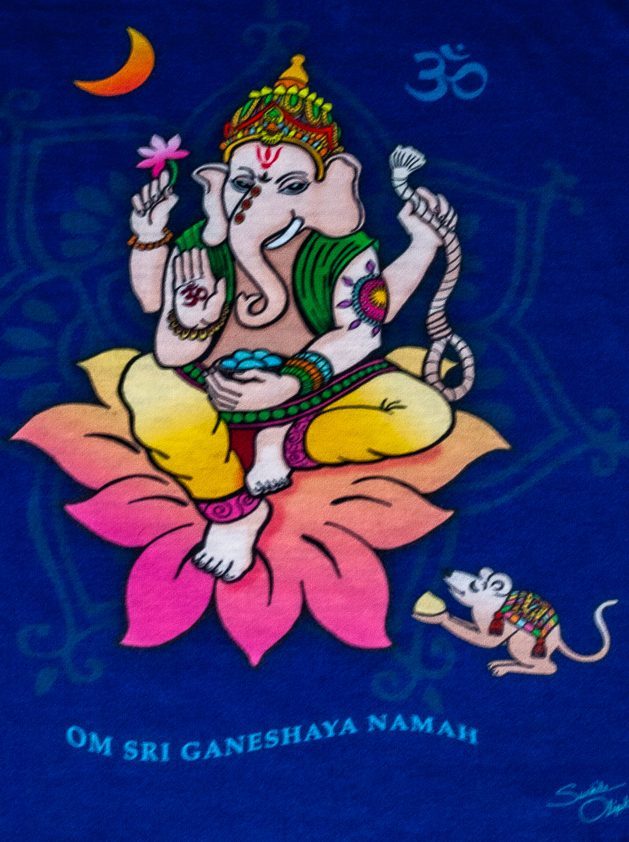
Several week ago I wore a t-shirt to class that had a picture of Ganesha on the front of the shirt. This brought forth a discussion on Ganesha. One of the students was particularly interested in this god. B is a student in one of my classes. She had a stroke years ago and as a result is paralyzed on the left side of her body. Nevertheless she participates wholeheartedly in the yoga class. What she cannot do she has learned to compensate with other variations of the poses. For some reason Ganesha resonated with her and she periodically brings up the topic of this god.
I began thinking of this god myself. Why do so many people look to Ganesha for help especially when there is some overriding obstacle that life deals. Isn’t it the same thing as putting your “intent” on some goal that you are trying to reach? I looked to Joseph Campbell for some help in explaining why these Indian gods are so prolific and so enticing. JC says:
“There is another important difference between the Hindu and the Western ideas. In the Biblical tradition, God creates man, but man cannot say that he is divine in the same sense that the Creator is, whereas in Hinduism, all things are incarnations of that power. We are the sparks from a single fire. And we are all fire. Hinduism believes in the omnipresence of the Supreme God in every individual. There is no “fall.” Man is not cut off from the divine. He requires only to bring the spontaneous activity of his mind to a state of stillness and he will experience that divine principle within him.”
Therefore, it is through the image of each god that God is worshiped. The worship of the many gods ensures that every aspect of life is included. The gods instruct and inspire. Each god is replete with a set of symbols and tales. So what is there about Ganesha that inspires my student? Well for one thing Ganesha is the Remover of Obstacles. Ganesha is a very popular god. His persona is one that is both man and elephant. If for example I wish to be able to deal with obstacles in my life I would bring Ganesha to mind. I might even decide to recite one of the many mantras to Ganesha. To me putting your intent on something is the same thing. Only here you have a tangible object to hold onto.
So today, August 1, 2016 I put Ganesha to the test in my class. He became the inspiration for the class. My students loved the story line and were enchanted by the symbolism. It was amusing and serious at the same time. I suggested that every time they saw a difficult pose as insurmountable for them that they call upon Ganesha and put their intent on finding a way to work with the pose.
Here is some of what I related to my class. There are many variations on the symbols and story of Ganesha’s birth, so what I present here is just one of the interpretations that I used for my class.
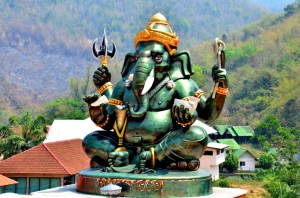
Ganesha’s tale: Ganesha is the son of Shiva and Parvati. Parvati wanted a son but Shiva did not want the responsibility of being a householder. Seeing that Parvati was depressed about this Shiva pulled a thread from the dress she wore and made a son from it. Parvati breast-fed the baby and he came to life. Shiva was surprised the Parvati fed life into a child that was made from fabric and warned her that the birth was an ill omen. As he spoke, the child’s head fell to the ground.
Parvati was inconsolable and Shiva tried unsuccessfully to put the head back on the child’s body. A voice came from the sky and said that the head of someone facing north would stick to the child. Shiva sent Nandi, the bull upon which he ride, to find such a person. Nandi found Indra’s elephant lying with his head facing north. He cut off his head and took it back to Shiva, who placed it upon the child. Thus, Ganesha was born. He is accepted as the god of beginnings of learning and wisdom and remover of obstacles.
Ganesha’s symbols:
Ganesha’s Elephant head symbolizes the “soul” and wisdom.
Ganesha’s body signifies our earthly existence.
Ganesha’s upper right hand holds a goad that helps to propel humankind forward on the eternal path and remove obstacles along the way.
Ganesha’s left hand holds a noose to capture difficulties.
Ganesha’s broken tusk is a symbol of sacrifice for writing the Mahabharata.
Ganesha’s Rosary symbolizes his pursuit of knowledge.
Ganesha holds a sweet in his left lower hand that indicates that one must discover the sweetness of the Atman or Soul.
Ganesha’s large ears represent his listening to our petitions.
The snake that drapes around his neck and body represents energy.
Ganesha rides on a mouse that represents humility.
I try to find themes for my yoga classes that reflect what my students are feeling or what particular aspects of their lives they are dealing with. Ganesha’s theme was different and a little whimsical in presentation but my students seemed to love the idea and now everyone wants their own Ganesha t-shirt.
Namaste
Postscript:
I ended this class on a serious note. The reading today at the end of the session:
Forces beyond your control can take away everything you possess except one thing, your freedom to choose how you will respond to the situation. You cannot control what happens to you in life, but you can always control what you will feel and do about what happens to you.” ~Viktor E. Frankl in Man’s Search fro Meaning
Ganesha helps us remove our obstacles but Viktor Frankl shows us how to respond when the obstacles are beyond our control.
 Yoga & Tai Chi