

The Merriam Webster word of the day for July 16 was “caesura” pronounced sih-ZYUR-uh. Caesura means a break or interruption. Caesuras are those slight pauses one makes as one reads verse. We often need these little stops to set the cadence and phrasing of natural speech into the metrical scheme. This word intrigued me because I thought about how well it related to yoga and tai chi. These little stops apply to yoga poses and to tai chi forms although in different ways.
There are caesuras between poses and within a pose much like poetry. During a yoga practice there is a rhythm or cadence to a sequence of poses that requires a caesura or slight pause between poses or even slight pauses as you find your way into a pose. Depending where you place these pauses you can create your own yoga poetry practice with different patterns or beats. Without these breaks the poses begin to morph into each other creating chaos. The asanas crumble into an amorphous structure that has no meaning. Then the entire practice unravels. But taking into consideration the small stops between and within poses will change your practice dramatically.
Take for example a simple yoga sequence: down dog to lunge (1) to warrior I (2) to warrior II (3) to triangle pose (4). 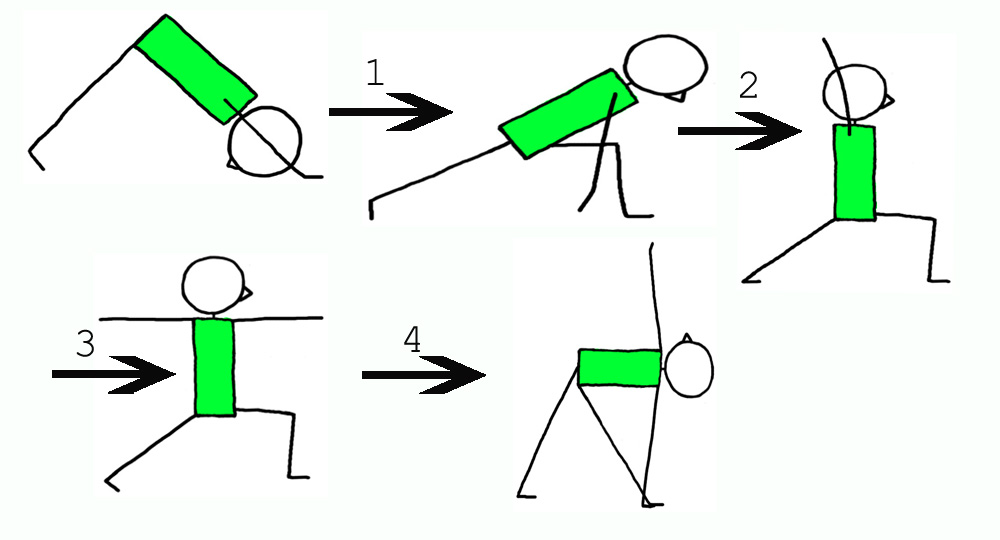
Consider some of the movement possibilities for these five poses. Each of these variations will create a different rhythm to your practice.
- You can practice all 5 poses as a quick sequence: exhale from down dog to lunge, inhale to warrior I, exhale to warrior II and inhale to triangle (Vinyasa style).
- You can decide to place a pause at each of the 4 steps. Perhaps pause for 1 full breath between poses then move on.
- You can choose to move through the poses as in #1 but hang out in one of the poses for a minute or so and watch what happens.
There are any number of ways you can move from pose to pose but carefully planning where you will pause and for how long will change the practice. Watching your internal reaction to a paused pose will allow an even deeper practice. The combination of poses, pauses, reactions and transitions, from one pose to another creates a myriad of possibilities that will change the rhythm and benefits of the yoga practice. There is no limit.
In the practice of tai chi too there are caesuras that impart a flow and a sense of poetry to the practice. The metrical rhythm is played out by the continual shifting of weight as we move from form to form. By sinking, turning and expanding as one all encompassing movement we create a flow of movement that shifts from form to form building a complete artistic work. You can’t flow in tai chi without the shifting of weight. The same is true for yoga but we don’t think of it that way. In tai chi play (for those who don’t know, practicing tai chi is called playing tai chi) it is important to know the next move. If you can’t remember what form follows from the one before then the only way to play is to follow someone who does know the sequence. But then the movement becomes just a nanosecond behind and it is just that tiny space that holds a skillful transition and produces that wonderful flow characteristic of tai chi. This is why it is so important in tai chi to memorize the sequence.
Continual mindfulness of pauses while on the yoga mat or while playing tai chi leads to mindfulness of activities off the mat. Eventually the practices become our life and our life becomes our practices. Both yoga and tai chi practices eventually play out to our personal story. The rhythm and flow of one form or pose to the next is exactly what happens in life. In practicing the forms and poses over and over again and noting our reactions we set ourselves up to flow with the changes that life may offer us.
Pause and think about it.
Namaste
 Yoga & Tai Chi