

Have you ever been in a yoga class where you are instructed to move from supine to standing, standing to kneeling, kneeling to prone, prone to standing, then down again to your knees. You get the gist. You are bobbing up and down like a yoyo. You begin to forget where you are or what you are doing or what comes next. Even the cues stop making sense. So you are prompted to move without thinking of where you are moving and how your will get there. Even if the instructor has a map of the poses planned for the class there is often no direct smooth connection from one orientation in space to another. This is unfortunate and takes away from a well planned yoga session. I believe that a good yoga class is more about how to move from sitting to standing or standing to sitting with little fuss and with gracefulness so the subsequent yoga poses can be executed with control and awareness. If you know what moves come before and after you can ease yourself into that luminal fertile space between poses where the world of yoga opens. Most of us are aware of the importance of moving from pose to pose but it is just as important to learn to change position or orientation with ease and control. This is why it is also important to plan how the class will proceed through all of its different phases.
The first transformational phase happens when you enter the yoga studio and you prepare to settle onto your mat before class begins. This is the transition from whatever you were doing outside the yoga studio to preparing for a yoga class. Gathering your props, setting out your mat, arranging the props where you may need them, are all parts of this stage. I have been in yoga studios where this is the time to chat, catch up on neighbor’s activities and to socialize. I prefer the studio where silence reigns and the yoga room is dimly lit with soft music playing in the background. It gives me time to make my own transitions from outside to the yoga class. If I am lucky I will even have a few minutes to meditate or stretch quietly. When the chime rings to start I am relaxed and ready.
The second transition happens when the instructor leads a centering and breathing practice. It may also include a short meditation time and the setting of an intention. Then the poses or asanas begin. Somehow though we need to move from our position in grounding and centering to where we will begin the poses. This involves a change in spatial orientation and it will take place several times during a class.
Moving from one group of poses to another takes some foresight. These moves involve significant changes in where the physical body is located in space. They refer to standing, kneeling, seated, supine, and prone. These changes in body position need to be made with thought and knowledge to make the whole practice a unity that flows so well that there are seemingly no sharp delineations between poses. I have found the only true way of changing position is to practice so slowly that you can trace every movement, write it down to work out the cues to use in a consistent manner. Here is an example of a few simple scripts that I use for my own practice and for cueing my students.
- From standing (tadasana) to a seated position (dandasana)
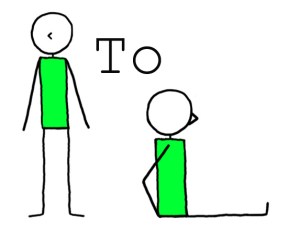
Starting Position: tadasana
- on inhale: circle your arms overhead
- on exhale: fold forward from the hips circling the arms down along the sides of your body to rest by your feet
- on inhale: press into your hands and step the right leg back, foot to the floor then knee to the floor. Follow with the other leg (table position)
- on exhale: lower one hip to the floor
- on inhale: swing your legs around to the front of your mat to come into dandasana (seated staff pose)
- From easy seating pose (sukhasana) to table position (bharmanasana)
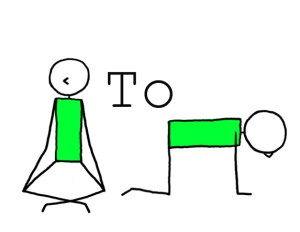
Starting position: easy sitting pose – sukhasana
- Exhale as you reach your arms forward on the floor. Walk your finger tips out away from you until you can lift your buttocks off the ground
- On inhale: come up on to your knees
- Exhale adjust your legs and arms to a comfortable position under your hips and shoulders
- Supine (lying on your back) to table pose (bharmanasana)
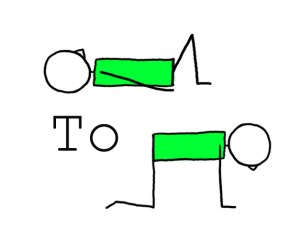
Starting position: lying on your back with knees flexed and feet flat on the floor
- on exhale: drop your knees to one side and roll over
- on inhale: push your top hand down onto the mat and push yourself up.
- on exhale: swing legs a few inches to the left
- on inhale: crawl forward onto your hands and knees coming into table position (bharmanasana)
- From standing (tadasana) to table (bharmanasana) see #1 above
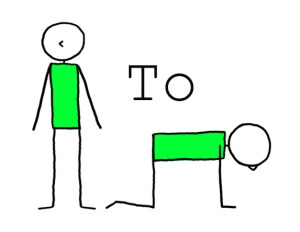
- From table position (bharmanasana) to prone (lying on your stomach)
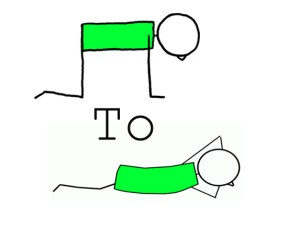
Starting position: table (bharmanasana)
- on exhale: walk arms forward as you guide your hips forward and down to the floor. Lower yourself to the ground, keeping elbows close to the ribs
- on inhale: cross arms and rest head on crossed arms
- From prone (on your belly) to standing (tadasana)
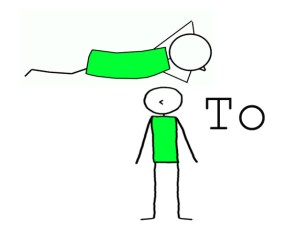
Starting position: in crocodile (makarasana) pose on your belly
- on inhale: press yourself up to table pose
- on exhale: turn the back toes under and lift hips to the sky. Settle the heels towards the earth.
- on inhale: lift the right leg to the sky
- on exhale: glide the leg forward to place the foot between the hands coming into a low lunge
- on inhale: glide the left foot forward to rest alongside the right foot
- exhale in position: lower chest to thighs, soften knees (uttanasana)
- on inhale: raise arms out to a “T” and circle them up overhead as you come up to standing mountain pose (tadasana)
- From seated staff pose (dandasana) to supine (reclining on back)
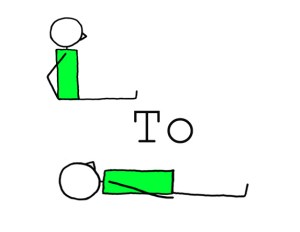
Starting Position: seated staff pose (dandasana)
- on inhale: bend knees and place feet flat on mat. Extend arms in front, shoulder height, palms facing each other
- on exhale: engage your core muscles as you slowly lower yourself to the floor
- Inhale: extend your legs out on the mat, arms by your sides
 Yoga & Tai Chi