
I am always looking for ways to inspire my students and myself. Chanting AUM has been an integral part of my yoga experience and the yin/yang symbol is becoming an integral part of how I do my tai chi. What do each of these symbols represent? What is their purpose is our endeavors to keep each art form alive and thriving. Here are some thoughts.
Aum
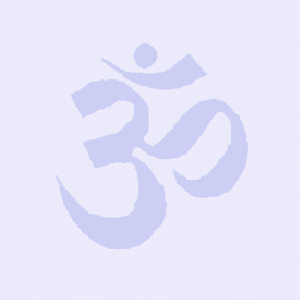
Chanting AUM in the beginning or end of a yoga class can be very risky. Many of the people in my classes over the years have associated ‘AUM’ with a religious connotation that is distasteful to many and can even cause people to be reticent about coming back to another yoga class. But here is a simple non-religious explanation that has always worked for me in my classes and that I myself, being trained as a chemist, find very soothing and plausible.
All things in existence are made up of vibrating, pulsing energy at their most essential level. This pulsing energy enters our awareness as a humming vibration; it is the sound of the universe itself. Or think of it as the sound that the earth would make as it turns on its axis without any other sound in the universe.
The letters are explained as:
“A” represents our waking state, this is the upper curve in the symbol
“U” is the dreaming state, the lower curve in the symbol
“M” is the dreamless state of deep sleep, the curve issuing from the center of the symbol.
The crescent shape above the upper curve stands for the veil of illusion that we live under and the dot is for the transcendental state. When the individual spirit passes through the veil and rests in the transcendental state she is liberated from the three states of waking, dreaming and dreamless, and their qualities. I guess then that this would be nirvana or the bliss state. What a wonderful way to envision the sound of AUM as a chant!
So Chanting “AUM” leads to meeting the Divine within ourselves.
The Tai Chi Symbol
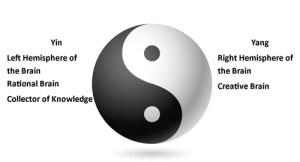
The tai chi symbol is less offensive to most people than the yoga ‘AUM’ as there is no religious connotation associated with this symbol. Also, there is no chanting associated with this symbol. I am finding that this symbol is a great teaching aide in its own right and a very powerful metaphor for understanding the principles of tai chi and yoga both. The symbol itself speaks to these principles.
- Balance: The yin (black or dark section) and yang (white or lighter section) are equal in size. This represents balance. Think of the human brain which is divided into two hemispheres, right and left. The right hemisphere of the brain, or the Yang portion, is credited with our creative nature. The left hemisphere, or the Yin portion is the rational, analytical side. Our American culture tends to encourage the left or Yin side of the brain. But to be truly balanced both sides of the brain need to be heard. The point where the white or yang portion of the symbol reaches its maximum size is the beginning of the black or yin portion, and vice versa. This speaks to the art of balance in life.
- Flow: When I practice tai chi I move from one form to another. I know the name of the form I am practicing and most of the time I know what comes after or how the forms follow one another. The tai chi symbol depicts this perfectly. As one form expands to its fullness it flows into the beginning of the next form. At its fullest point the white section of the tai chi symbol chases or merges into the tail of the black section and as the black section expands it chases the tail of the white section. It becomes all one form with no starts and stops or pauses. The practice becomes smooth, continuous and slow.
- Wholeness or Unity: Now think of the yin/yang symbol as distinct parts or sections within a whole. There is the black section and the white section but they are encased in a circle – representing the whole. Equating this to our practice while we learn individual forms, when we practice utilizing all the principles of tai chi the entire sequence is really only one form, i.e the circle encasing the parts.
- Yin without Yang and Yang without Yin does not exist: Neither the white portion nor the dark portion is totally yin or yang. The dark portion of the symbol contains a white dot, and the white section contains a black dot. We are not completely all one or the other and even if we think we are, the symbol reminds us that there is within each divide a portion of its counterpart and all the attributes associated with that counterpart.
- Transformation: Yin and Yang are constantly transforming as shown by the curving line and the circle. The tai chi symbol itself is not static. All the lines are curved and the overall symbol is one of a circle that has an infinite number of points. In this curved symbol Yin and Yang are constantly transforming as is true for all life.
The art of the practice of Tai Chi is to bring us into balance. The tai chi symbol shows us this. But the art of yoga does much the same.
In my next post I will elaborate a little more on the similarities of these two ancient art forms.
 Yoga & Tai Chi
3 responses to “The Symbol of Yoga and the Symbol of Tai Chi: What do they represent, and are they helpful tools for teaching?”
What a great article. I am new to WordPress! As I understand it, and this is only my experience over the last twenty years or so, the root of all or most of the archetypal Symbolism used pre dates Chinese or even Vedic culture, so they all have the same origins as they are expressing the same philosophy but in a way the culture at the time created.
LikeLike
Thank you for your comment. I agree with you. The more I delve into the underpinnings of these art forms the more they seem to have the same roots.
LikeLike
I profoundly disagree with your image where the left brain is associated with the yin aspect while the Yang aspect attaching to the right hemisphere.
The Left Hemisphere is Categorical, Rigid, Rational and Exclusive. It believes it contains the truth where as the right hemisphere Encompass, Adapts, Intuits and Includes. See Ian Mc Gilchrist’s : Master and his Emissary for a thorough overview.
Thanks
LikeLike